

Gardening & Growing
Raised garden beds, greenhouses, plant stands and plant-care tools for growing spaces of different sizes.
Room to grow
From the first garden bed to a place for every tool.
Make a garden that is rewarding to grow and practical to look after. Find raised beds, greenhouses and plant-care essentials, alongside sheds and outdoor storage that keep the working side organised.

Two connected parts of a workable garden: a place for plants and a place for the things that help you care for them.
A few considered choices can make the everyday jobs much easier.

Start with what you want to grow, then choose the planting depth and access around the bed. A bed you can tend from the edges is easier to maintain without stepping on the soil.
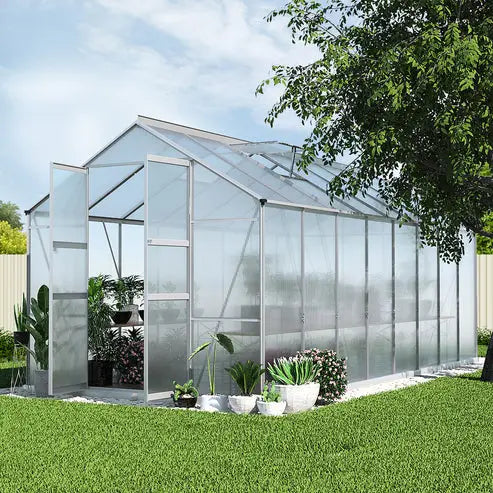
A greenhouse needs more than a patch of ground. Leave room to open the door, move plants in and out and reach the ventilation points as the weather changes.

List the longest, tallest and most awkward items you need to store. The doorway, lid opening and usable interior matter as much as the outside dimensions.
Think through a normal day in the garden: carrying a watering can, reaching the middle of a bed and putting tools away. Good access matters as much as the space a product occupies.
Trace the route from your tap to the growing area. Leave somewhere to put a watering can down, and avoid a layout where a hose must cross the main walking route every time you water.
Reach the middle of a bed before settling on its width. Around a greenhouse or storage unit, allow for open doors and the space needed to carry trays, pots or long tools.
An empty planter is easier to move than one filled with soil and water. Decide its position first, then work out the usable planting volume rather than treating the full outside height as soil depth.
Useful distinctions for choosing growing spaces and garden storage.
An open-bottom raised bed sits over the ground, so the surface beneath it is part of the growing setup. A planter on legs holds its growing mix in a contained base and brings the planting area higher. Choose around the surface available, the plants’ root space and how you want to reach them; a tall outside dimension does not always mean a deep planting area.
Choose a design intended for that setup and plan where water can drain. An open-bottom frame on soil and a contained planter on paving behave differently: roots and water cannot move into paving as they can into garden soil. Account for the filled weight and the available planting depth before settling on the position.
Measure the internal length and width and the depth you intend to fill. Multiply those three measurements in metres to get cubic metres, then multiply by 1,000 for litres. For example, 1.2 m × 0.6 m × 0.3 m is 0.216 m³, or about 216 litres. Curved walls, internal supports and space left at the top can change the usable volume.
A shed generally gives you more height for long-handled tools and room to arrange shelves; a box suits lower items that you can lift out from above. Work out how you will retrieve the item you use most, including the open door or lid. Keep moisture-sensitive supplies in storage suited to their needs rather than assuming every outdoor unit is waterproof.
