

Choose a manual backpack sprayer for short jobs if you are comfortable pumping a lever. Choose a battery model when reducing repeated pumping matters more than avoiding a charging routine. Either way, the tank still sits on your back, so compare the filled weight before moving up a size.
For a direct comparison, start with the Giantz 15 L hand-pumped sprayer and the Giantz 16 L battery sprayer, or browse all backpack sprayers. The difference is more than an extra litre: these models use different pumping systems and have different empty weights.
Before choosing either, match the sprayer and nozzle to the liquid and application permitted by the product label. Higher advertised pressure is not a shortcut to better weed control.
On this page
Manual or battery powered?
| Choice | What changes | What to check before buying |
|---|---|---|
| Hand-pumped sprayer | The operator supplies the pumping effort. There is no battery charging routine. | Handle position, required pumping effort, seals and the manufacturer's permitted operating pressure. |
| Battery-powered sprayer | An electric pump supplies pressure. The battery and charger become part of the maintenance routine. | Battery type, approved charger, replacement availability and the conditions behind any runtime claim. |
For occasional short tasks, a hand-pumped design may suit someone comfortable operating the lever. For longer work, a battery pump may reduce repetitive pumping, but it does not remove the weight of the tank. Neither type is automatically compatible with every herbicide, fertiliser, detergent or solvent.
Choose a tank size you can carry
Compare the empty equipment weight plus the intended liquid load, rather than capacity alone. As a simple water-only illustration, 15 litres of water adds approximately 15 kg before the sprayer itself; a chemical mixture can have a different density. This is a weight illustration, not a mixing instruction or a recommended load.
A larger tank may reduce refilling, but only when the task calls for that volume and you can handle the resulting load. Do not assume you need to fill it completely. Check the equipment instructions for usable fill limits, and consider how you will lift, put on and remove the unit. The right capacity also depends on the permitted application method and the area to be treated.
Two backpack sprayers to compare
These examples use the specifications currently listed in our catalogue. They are a starting point for comparison, not a hands-on performance ranking or confirmation of compatibility with a particular chemical.
| Product | Listed capacity and empty weight | Listed features to compare |
|---|---|---|
| Giantz 15L backpack sprayer | 15L; 3.67 kg | Left- or right-side pump handle, padded straps, four nozzle types and a 760 mm lance. |
| Giantz 16L electric backpack sprayer | 16L; 4 kg net weight | 12V 6.5Ah lead-acid battery, padded straps, four nozzle types and an 800–1,200 mm spray lance. |
For a full tank of water, the listed figures work out to approximately 18.7 kg for the manual 15 L model and 20 kg for the electric 16 L model, including the equipment. These are water-only illustrations, not recommended loads or chemical-mixing quantities. You do not have to choose the larger load simply because a battery does the pumping.
The electric model lists a lead-acid battery, so check its charging instructions and charger inclusions before ordering. Compare the current product pages and supplied manuals; pressure and runtime figures are useful only when their units and operating conditions are comparable.
Nozzle choice starts with the application
An adjustable nozzle is useful only when it can deliver the application the label and sprayer instructions require. Do not choose a fine mist simply because it covers a wide area: droplets can move beyond the intended target. Follow the chemical label's equipment, spray-quality and weather directions. The APVMA's guidance on spraying chemicals explains the role of equipment checks and correct use.
Ask the supplier to confirm compatibility of the tank, seals, hoses and pump with your intended product. The words “weed sprayer” do not establish compatibility with every formulation. If you are choosing equipment for a Roundup-labelled product, our guide to finding the exact label and dilution instructions explains why brand name and tank volume alone are insufficient.
Look beyond the tank
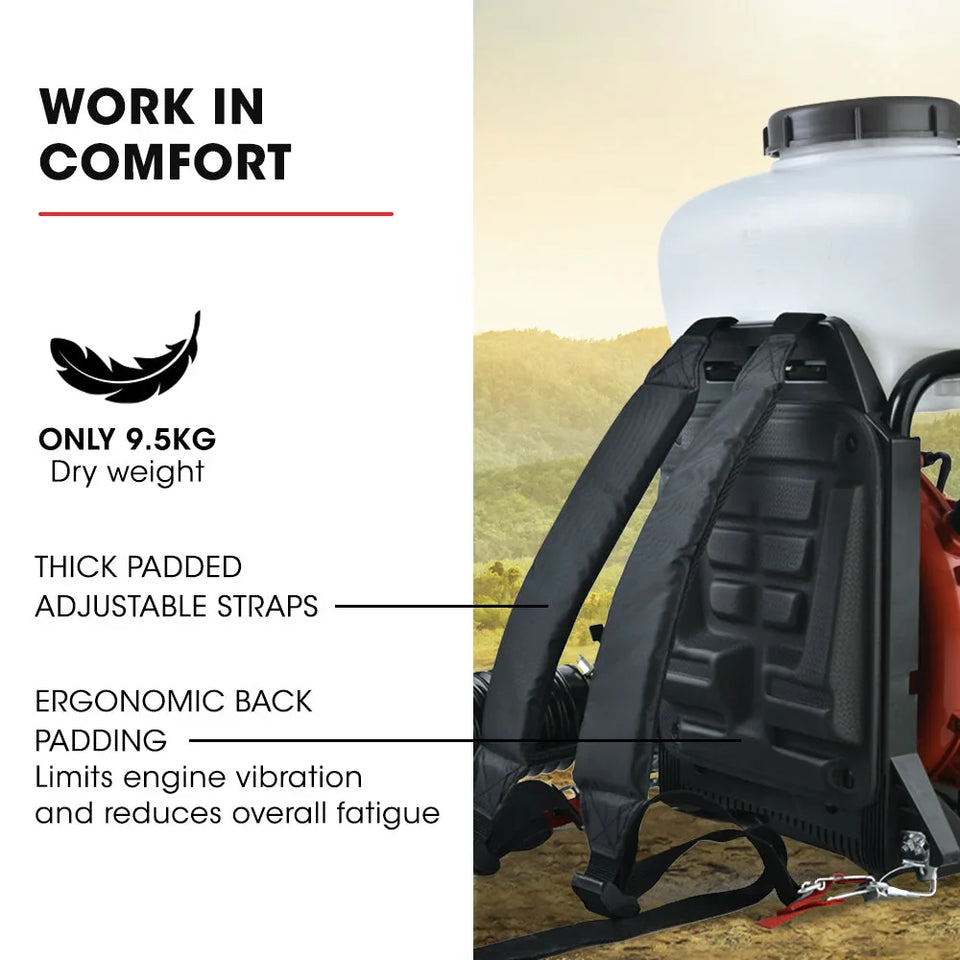
- Harness and fit: check strap adjustment, padding, handle reach and whether the unit can be handled comfortably at the intended load.
- Filling and inspection: compare the opening, strainer, readable markings and access to hoses and seals.
- Cleaning: look for a clear manufacturer procedure and accessible service parts. Plan how to manage rinsate under the chemical label and local requirements.
- Parts and charging: check replacement nozzles, seals and battery support before committing to a model.
- Storage: follow the manual's storage and battery instructions rather than assuming every unit can remain outside in sun or rain.
For the maintenance side of ownership, read Backpack Sprayer Lifespan: Storage and Maintenance. A documented care routine is more useful than an unsupported promise that a sprayer will last a particular number of years.
Common buying questions
Is a battery sprayer always better than a manual one?
No. It changes the source of pumping effort, but adds battery and charging requirements. Compare the complete equipment, load, task and maintenance needs.
Is 15L or 16L the right size for my garden?
Garden size alone is not enough to decide. Start with the permitted application, the amount needed and the filled weight you can safely handle. Check usable tank capacity in the manual.
Does a higher pressure mean better weed control?
No. Equipment settings must match the specified application. More pressure is not a substitute for the correct nozzle, coverage or label directions.
Compare the current backpack sprayer range, or read our overview of backpack sprayer types if you are still deciding how the pump should operate.


